


Solar Surveillance Trailers vs. Security Guards: Which Costs Less?
A construction site may be quiet after 6 p.m., but the tools and equipment are still there. Someone needs to keep an eye on them.
A guard is one option. A solar surveillance trailer is another, especially without reliable electricity. Which makes more sense depends on the site and the length of the job.

Start with the Guard Hours
Let's use an example. At a security service rate of $30 per hour, one guard working eight hours a day costs $7,200 over 30 days. For 24-hour coverage, that rises to $21,600. These are examples, not market averages; actual rates vary.
Guards can check credentials, speak to visitors and respond in person. Cameras can't do those things. But if the main task is watching an empty equipment yard overnight, does every hour really need an on-site person?
With suitable cameras, connectivity and monitoring, a mobile CCTV trailer lets a team view the site remotely and investigate alerts. Someone still needs to decide what to do when an incident occurs. It can't respond physically.
What Does a Solar Trailer Cost?
Buying a trailer means an upfront investment plus shipping, connectivity, maintenance and possibly monitoring fees. That's different from daily guard fees.
A trailer can also move between projects. A security company might deploy one at a construction site, then relocate it to a storage yard when the first job ends. This matters for companies with recurring contracts.
For a two-week event, hiring a guard or renting equipment might make more sense. For repeated deployments, owning a trailer may be easier to justify. Utilization matters.
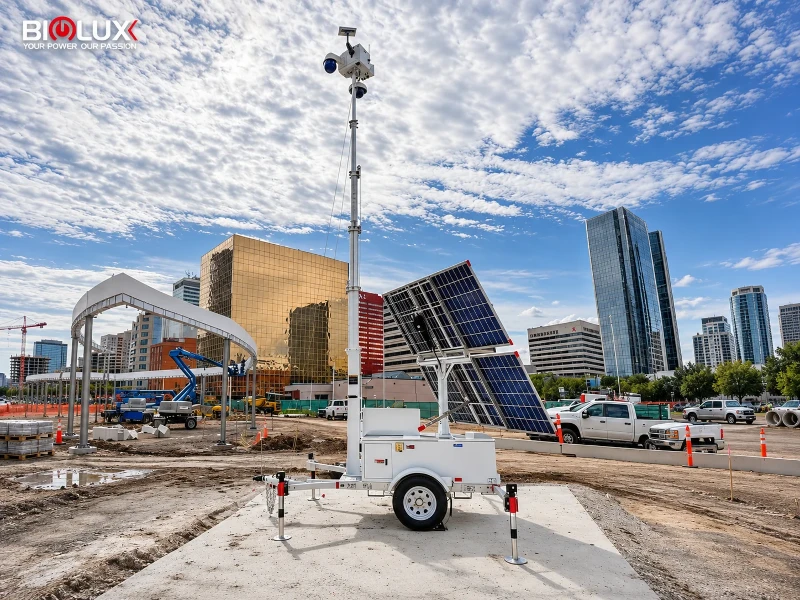
At BIGLUX, We Start with the Power Load
One customer in Washington State wanted to use his own cameras and add Starlink Mini for connectivity. His cameras alone would draw around 90W. Starlink would add to that load, and the deployment location had limited sunlight.
For this project, we recommended upgrading from the standard two 450W panels to two 600W panels. The additional solar capacity would help with charging, but we still needed to consider battery storage and how the system would cope with consecutive cloudy days.
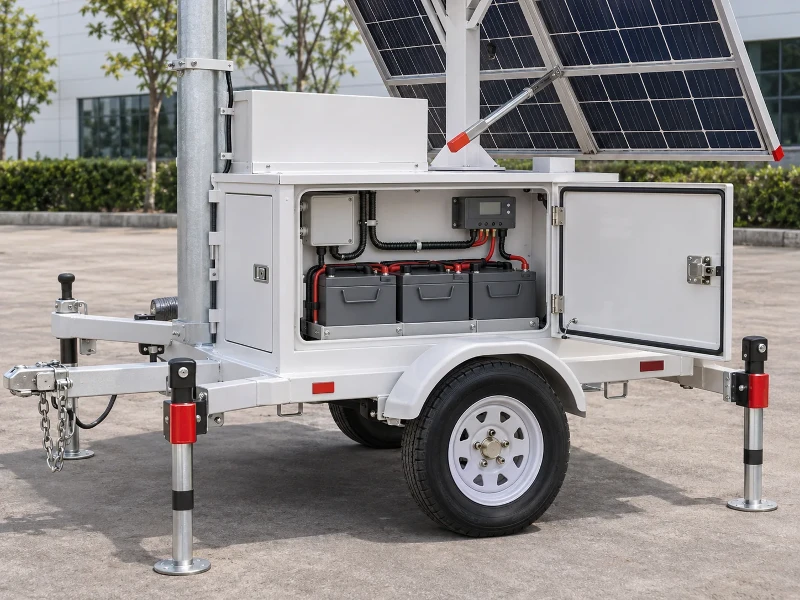
This is why we ask what customers plan to install before recommending a trailer. Cameras are only part of the power budget. A router, NVR, Starlink terminal and other accessories all draw from the same battery.
Our standard HiSOLO comes with two 450W solar panels, with a two 600W option available for projects that need more solar capacity. However, 900W of solar panels does not mean the trailer can continuously power 900W of equipment. Panels generate electricity during daylight hours, while the equipment may run all night.
Before choosing a configuration, send us your device list and deployment location. That gives us a more useful starting point than the number of cameras alone.
When Does a Trailer Make Sense?
Solar trailers are useful for construction sites, equipment yards, vacant properties and parking areas where a permanent CCTV installation isn't practical. The raised mast provides a better camera position, and the trailer can move with the project.
Guards are still important for access control, visitor management and physical intervention. Some sites need both: video coverage for routine observation and people available when something happens.
It's also worth separating the hardware from the monitoring service. BIGLUX manufactures the solar-powered trailer platform. Customers can install compatible PTZ cameras, bullet cameras, NVRs and networking equipment. AI features such as person detection or vehicle recognition depend on the cameras and software chosen, not the trailer itself.
For security integrators and rental companies, a trailer can also become part of a service offering. Consider utilization, monitoring, maintenance and response arrangements before buying.
Frequently Asked Questions
Are solar surveillance trailers cheaper than security guards?
They can be when remote monitoring reduces paid guard hours over time. Compare the total trailer cost with the guard hours realistically reduced, rather than assuming all guards can be removed.
Can I install my own cameras on a BIGLUX trailer?
Yes, if the devices are compatible with the electrical and mounting setup. Share your camera list and total wattage so we can check the configuration.
Will it work at night or through cloudy weather?
Batteries power the equipment when solar production is low. Runtime depends on the battery, equipment load, temperature and sunlight. Long cloudy periods must be considered before deployment.
Does a BIGLUX trailer include AI surveillance?
AI analytics come from compatible cameras, recorders and software. The trailer provides the mobile structure and off-grid power; it doesn't provide an AI monitoring service by itself.
What details do you need for a quotation?
The device list and power consumption, deployment location, preferred mast height and required battery backup are a useful starting point. We'll recommend a suitable configuration.