


How to Choose the Right Battery for a Solar Surveillance Trailer
Choosing the right battery is one of the most important steps when configuring a solar surveillance trailer.
The battery does more than store energy. It directly affects system runtime, winter performance, maintenance cost and overall reliability.
For most solar CCTV trailer applications, four battery options are commonly considered:
- GEL battery
- LiFePO4 (LFP) battery
- Lead-sodium battery
- LFP battery with heater
There is no single battery that is best for every project. The right choice depends on climate, equipment load, cycling frequency, backup time and budget.
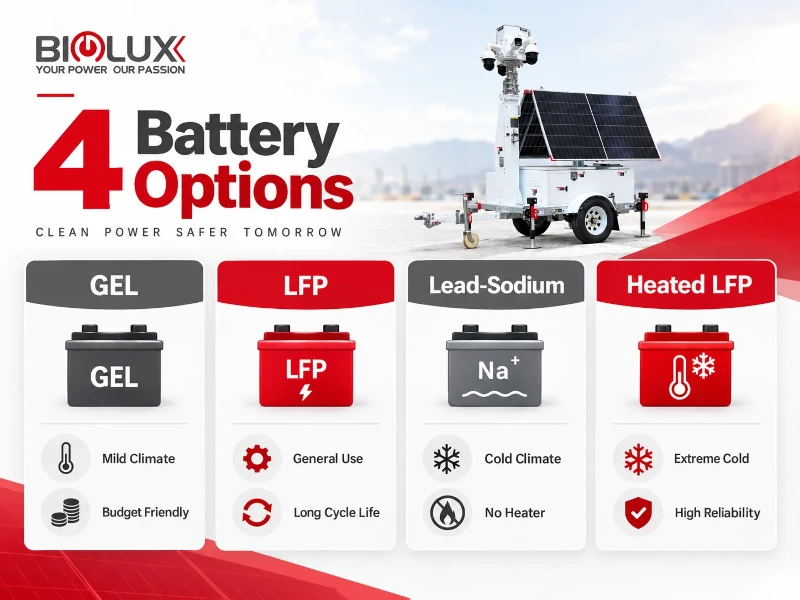
1. GEL Battery: Cost-Effective for Mild Climates
GEL batteries are a mature sealed lead-acid solution widely used in solar and backup power systems.
Their main advantage is cost. For customers who need a reliable but economical solution, GEL can still be a practical option.
Best for:
Mild or warm climates
Budget-sensitive projects
Low to moderate CCTV loads
Less demanding applications
GEL batteries are maintenance-free and easy to integrate with common solar controllers.
However, they are relatively heavy and normally offer less usable capacity than LFP batteries with the same nominal energy rating. Their cycle life is also generally lower when deeply discharged frequently.
For a basic construction site with several cameras and a 4G router, GEL can be a good choice if winter temperature is not a major concern.
Recommended when: initial cost is more important than weight, maximum usable capacity or long cycle life.
2. LFP Battery: The Best All-Round Choice
LiFePO4, or LFP, is now one of the most common battery choices for modern solar surveillance trailers.
Compared with traditional lead-based batteries, LFP provides higher usable capacity, longer cycle life and lower weight.
Best for:
Construction sites
Truck yards
Parking areas
Rental surveillance fleets
Temporary security projects
Remote CCTV systems
A surveillance trailer may charge and discharge every day, so cycle life becomes very important. LFP is well suited to this kind of frequent cycling.
Another advantage is weight. A lighter battery system helps reduce trailer weight and makes mobile deployment easier.
The main limitation is cold-weather charging.
Standard LFP batteries normally require charging protection when cell temperature becomes too low. This means a battery may still power the CCTV system in cold weather, but charging may be limited until the battery temperature rises.
Recommended when: the trailer operates in mild, warm or moderate climates and long cycle life is important.
3. Lead-Sodium Battery: A Cold-Climate Alternative
Lead-sodium batteries are an enhanced lead-based battery option designed to provide better low-temperature performance than conventional lead-acid solutions.
They should not be confused with sodium-ion batteries.
For solar surveillance trailers, lead-sodium can be especially useful in colder regions where standard LFP charging limitations may become a concern.
Best for:
Cold climates
Remote sites
Winter construction projects
Cost-sensitive cold-weather applications
Customers who prefer a lead-based battery system
Its main advantage is improved suitability for low-temperature environments without requiring a battery heating system.
This can reduce system complexity and heater-related power consumption.
However, lead-sodium batteries are still relatively heavy compared with LFP, and the technology is less familiar to many international buyers.
Actual operating temperature, cycle life and charging parameters should always be confirmed according to the battery specification.
Recommended when: the project operates in a cold environment but does not require the higher-cost heated LFP solution.
4. LFP with Heater: For Extreme Cold
For demanding winter applications, LFP batteries with an integrated heater offer another solution.
The principle is simple: when the battery is too cold to charge safely, the heating system increases the battery temperature before normal charging begins.
Best for:
- Canada
- Alaska
- Northern United States
- Northern Europe
- Oil and gas sites
- Critical infrastructure
- 24/7 surveillance projects
This allows customers to keep the advantages of LFP, including lower weight, high usable capacity and long cycle life, while improving winter charging reliability.
However, the heater itself consumes power.
For example, a 100W heater operating for five hours uses:
100W × 5 hours = 500Wh
That energy must be included when calculating the battery and solar panel capacity.
This is why cold-weather system design should consider not only CCTV consumption, but also heater consumption, winter solar production and required backup days.
Recommended when: the project operates in severe cold and reliability is more important than the lowest upfront cost.
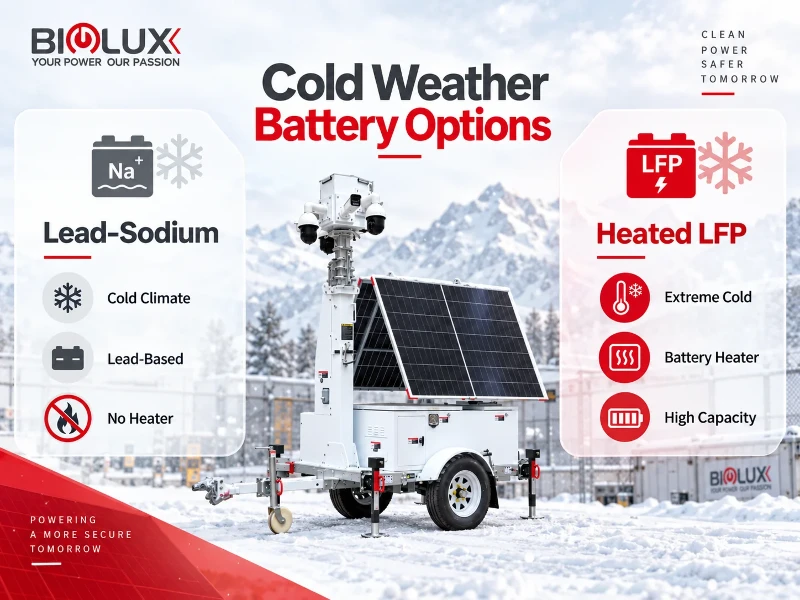
Quick Battery Selection Guide
| Battery Type | Best For | Main Advantage | Main Limitation |
|---|---|---|---|
| GEL | Mild climate, low-budget projects | Lower cost | Heavy, lower usable capacity |
| LFP | Most CCTV trailer applications | Long cycle life, lightweight | Cold charging limitation |
| Lead-Sodium | Cold-weather projects | Better low-temperature suitability | Heavier than LFP |
| Heated LFP | Extreme cold and critical applications | LFP performance in winter | Higher cost and heater consumption |
A simple selection rule is:
Mild climate + limited budget → GEL
General surveillance applications → LFP
Cold climate + cost-sensitive project → Lead-Sodium
Extreme cold + high reliability requirement → Heated LFP
Battery Capacity Still Matters
Choosing the right battery chemistry is only the first step.
The battery capacity must also match the actual equipment load.
For example, if a CCTV system consumes 40W continuously:
40W × 24 hours = 960Wh per day
If three days of backup are required:
960Wh × 3 days = 2,880Wh
In real applications, additional capacity should also be considered for depth of discharge, system loss, battery aging, low temperature, poor weather and heater consumption.
This is why two trailers using exactly the same cameras may require completely different battery configurations in California and Canada.
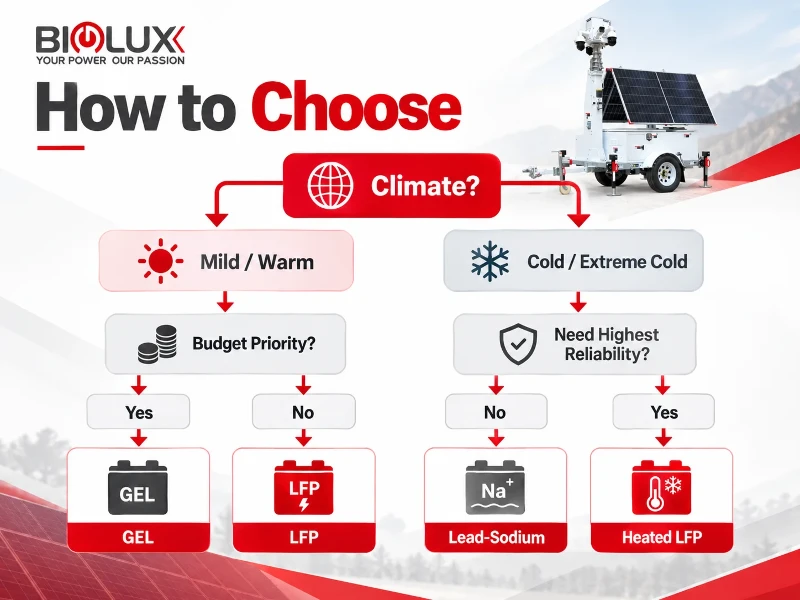
Q&A
Q1: Which battery is best for a solar surveillance trailer?
For most general applications, LFP provides a good balance of usable capacity, weight and cycle life. GEL is better suited to budget-sensitive projects, while lead-sodium and heated LFP are more suitable for cold-weather applications.
Q2: Which battery is better for cold climates?
For cold environments, lead-sodium or heated LFP is usually more suitable than standard LFP. The final choice depends on temperature, budget and reliability requirements.
Q3: How do I know what battery capacity I need?
The calculation should consider equipment power consumption, operating hours, required backup days, local temperature, solar conditions and battery type.