


Xi Jinping: In 2030, the total installed capacity of solar and wind power will exceed 1,200GW, and non-fossil energy will account for about 25% of primary energy consumption
On December 12, President Xi Jinping delivered an important speech titled "Continuing the past and opening a new journey of global response to climate change" through a video at the Climate Ambition Summit, announcing a series of new measures for China's national independent contributions.
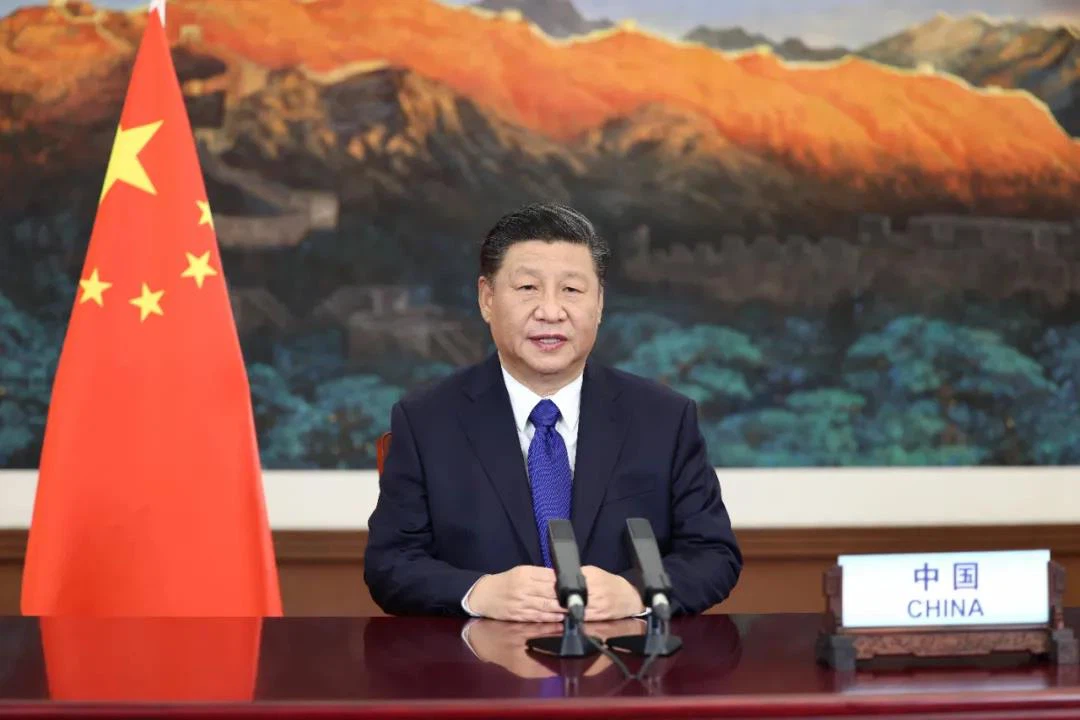
President Xi Jinping (photo by Xinhua News Agency reporter Ju Peng)
At the summit, Xi Jinping emphasized that by 2030, China’s carbon dioxide emissions per unit of GDP will be reduced by more than 65% compared to 2005, non-fossil energy will account for about 25% of primary energy consumption, and forest reserves will increase by 60% compared to 2005. 100 million cubic meters, the total installed capacity of wind power and solar power will reach more than 1.2 billion kilowatts.
According to data from the National New Energy Consumption Monitoring and Early Warning Center, as of the end of September, China's wind power and photovoltaic grid-connected installed capacity reached 220 million kilowatts, a total of 440 million kilowatts. There is still a gap of nearly 750 million kilowatts from the cumulative installed capacity of 1.2 billion kilowatts of solar and wind power in 2030. If this data is calculated on a 10-year average, it means that the annual new installed capacity of wind and light will not be less than 75GW.
What needs to be emphasized is that since the goal of "carbon peak in 2030" was set, the major power central enterprises and state-owned enterprises have stepped up the development of new energy. Previously, PV companies did not complete statistics. More than 39GW of new energy projects. Huaneng, SPIC, National Energy Group, China General Nuclear Power Corporation, China Three Gorges New Energy have previously drawn up about 220GW of new energy projects in the next five years in the "14th Five-Year" new energy plan, and SPIC has signed 21GW+ The new energy project announced recently that it will achieve the “carbon peak” in China ahead of schedule by 2023.
In addition, the provincial governments are also actively planning under this goal. According to public information statistics, as of now, more than a dozen provinces including Hubei, Guangdong, Shandong, Inner Mongolia, etc. have completed the filing or filing of about 70GW of photovoltaic projects in 2020. Sign up. Several tens of millions of kilowatts of new energy bases in Yunnan, Sichuan, Xinjiang, Qinghai, Gansu and other places are actively preparing and promoting. Yunnan has recently completed the 11GW wind and solar project optimization work.
In fact, as of the end of 2019, domestic non-fossil energy accounted for only 15.3% of primary energy consumption. Earlier, Yi Yuechun, deputy dean of the China Hydropower and Water Conservancy Planning and Design Institute, said at the "China New Energy and Electricity Roundtable (Photovoltaic)" thematic exchange meeting that for every 1% increase in the proportion of non-fossil energy, new energy should be added The installed capacity of renewable energy is 100 million kW.
The minimum annual average of 75GW of new installed capacity of photovoltaic and wind power may not meet the 25% target. Combined with the action plans of local governments and central power enterprises, the average annual new installed capacity of wind and light in the next (ten years) may exceed 100GW. .
The following is Xi Jinping's speech at the Climate Ambition Summit:
Carry on the past and open the new journey of global response to climate change
——Speech at the Climate Ambition Summit
(December 12, 2020, Beijing)
Xi Jinping, President of the People's Republic of China
Dear Secretary-General Guterres,
Dear colleagues:
It is a great pleasure to attend today's climate ambition summit. Five years ago, leaders of various countries used the greatest political determination and wisdom to promote the conclusion of the Paris Agreement to address climate change. In the past five years, the "Paris Agreement" has entered the implementation stage and has received extensive support and participation from the international community. At present, the international pattern is evolving rapidly, the new crown pneumonia epidemic has triggered a deep reflection on the relationship between man and nature, and the future of global climate governance has attracted more attention. Here, I propose three suggestions.
First, unite as one to create a new situation in climate governance featuring win-win cooperation. Faced with the challenge of climate change, mankind shares a common destiny, and unilateralism has no way out. Only by adhering to multilateralism, emphasizing unity and promoting cooperation can we achieve mutual benefit and win-win results and benefit the people of all countries. China welcomes all countries to support the Paris Agreement and make greater contributions to combating climate change.
Second, boost ambitions and form a new system of climate governance that does its best. Countries should follow the principle of common but differentiated responsibilities and strengthen actions to the greatest extent based on their national conditions and capabilities. At the same time, developed countries should earnestly increase the provision of funds, technology, and capacity building support to developing countries.
Third, strengthen confidence and adhere to the new idea of green recovery in climate governance. Green water and green mountains are Jinshan Yinshan. We must vigorously advocate green and low-carbon production and lifestyles, and seek development opportunities and motivations from green development.
China has made important contributions to reaching the Paris Agreement to address climate change and is also an active practitioner in implementing the Paris Agreement. In September of this year, I announced that China will increase its nationally determined contributions, adopt more powerful policies and measures, strive to reach the peak of carbon dioxide emissions by 2030, and strive to achieve carbon neutrality by 2060.
Here, I would like to further announce that by 2030, China’s carbon dioxide emissions per unit of GDP will be reduced by more than 65% compared to 2005, non-fossil energy will account for about 25% of primary energy consumption, and forest reserves will be higher than in 2005. With an increase of 6 billion cubic meters, the total installed capacity of wind power and solar power will reach over 1.2 billion kilowatts.
China has always kept its promises and will be guided by new development concepts to promote a comprehensive green transformation of economic and social development while promoting high-quality development, implement the above goals down-to-earth, and make greater contributions to the global response to climate change.
Dear colleagues!
"The sky does not speak but the four seasons walk, the earth does not speak but all things live." The earth is the common and only home of mankind. Let us carry forward the past and move forward side by side, help the "Paris Agreement" to be stable and long-term, and start a new journey of global response to climate change!
thank you all.