




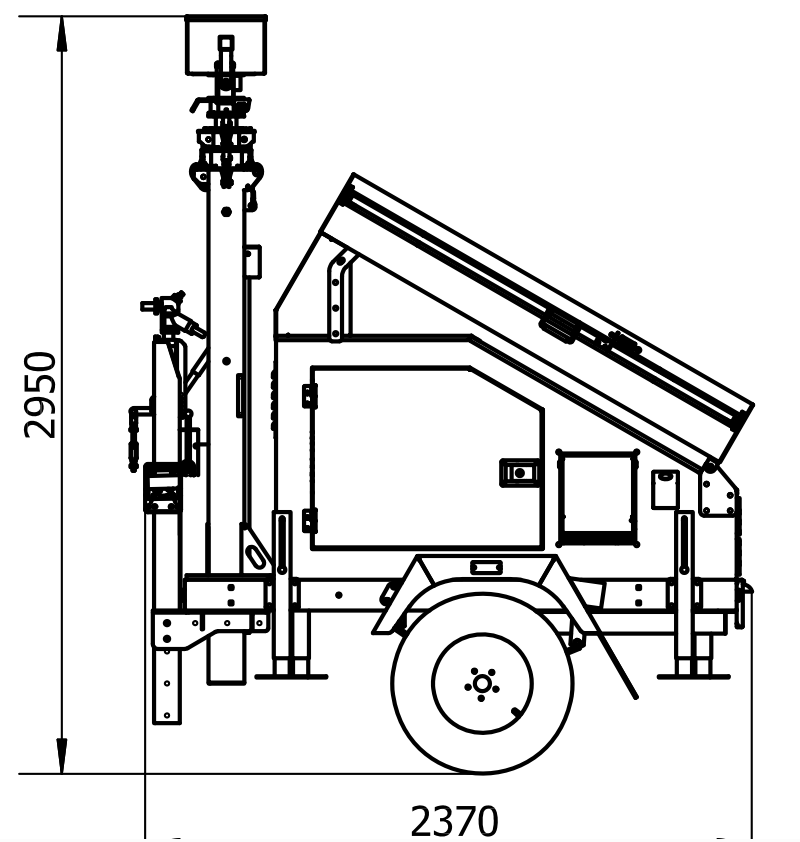
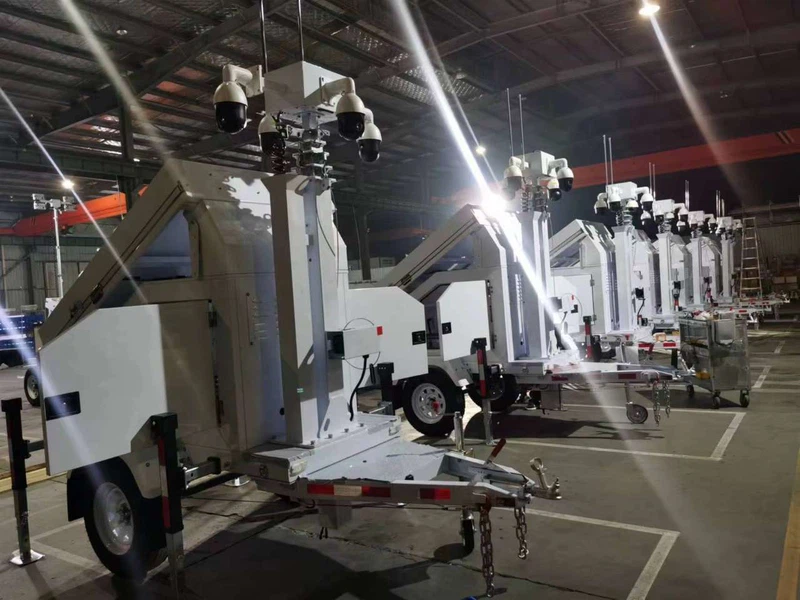
There are 3 main parts of Biglux Solar Powered Mobile CCTV Tower: Solar system, Trailer system with telescopic mast and the CCTV system.
You can install your own camera system locally and we will prepare a mounting box with spring cables for easy connection.
And of course we can install and wire all the Camera system already on the trailer for you too. Please just let us know the function of cameras you prefer to.

Some data of Solar Powered Mobile Camera Tower for your reference.
| Model Number | BL3P-G7MHS |
| Application | Industrial, construction, commercial |
| Solar Panel Type | Monocrystalline Silicon |
| Battery Type | GEL batteries |
| Controller Type | MPPT |
| Solar Panel | 3pcs 435w |
| Battery | 6pcs 150Ah, DC12V, 10800Wh |
| Controller | 60A MPPT, 95% Efficiency |
| Mounting Box | Prepared, easy for camera connection |
| Spring Cables | 2 Cat6 + 2 Supply |
| Inverter (Optional) | Optional |
| Cameras | Optional (eg: 4 Hikvision dome cameras or other options) |
| LED Light (Optional) | Optional (eg: 2 * 50W led light ) |
| Mast | 5 section 6.5 meter manual lifting telescopic mast |
| Charging time | 6.9 hours by solar |
| Running time | 72 hours for 120W with a full charge at 80% DOD |
| Trailer | US AU and EU standard with single axis, 4 outriggers, Ring and Ball hitch |
Usually we customize the configurations accoridng to you needs.
If you have any project requirement, please let us know more details, we can make customized solutions for you accordingly, such as light wattage, height of the telescopic mast, battery qty, etc.
The foldable tow bar is available for Solar Powered Mobile Camera Tower
Some industry news about new energy and photovoltaics for reference:
Distributed, ubiquitous, and lowest cost. Micro and microgrids will win. With this kind of electricity, African countries can reduce pollution, desalinate sea water, create jobs and hopefully get rid of fossil fuel vehicles. From Afrik 21's source, here's this month's roundup of solar news from the green and gold continents.
Ghana Solar Microgrid
That's good news for some of Ghana's 32 million residents in West Africa. Approximately $58 million will be provided as grants for off-grid electrical systems. The $28 million will come from the African Development Bank (AfDB) under its Scaling Up Renewable Energy in Low-Income Countries (SREP) program through the Climate Investment Fund (CIF). The Ghanaian government will also contribute US$16 million and the Swiss State Secretariat for Economic Affairs will contribute US$13.3 million.
“The Ghanaian government plans to install 35 solar photovoltaic micro-grids and build stand-alone solar systems in 400 schools, 200 health centers and 100 community energy service systems in Lake Volta and the northern region. Island communities will be suitable for small and medium-sized enterprises Install 12,000 rooftop solar systems with batteries. The Abidjan, Ivory Coast-based financial institution says the work is expected to "close the gender gap in outcomes by creating 2,865 equitable jobs and livelihoods, 30 percent of which will be used for women and youth".
Floating solar power in Seychelles
The Republic of Seychelles is an archipelagic country consisting of 115 islands, located 1,500 kilometers off the east coast of the African continent, with a population of about 100,000.
Despite delays, France's Qair has finally made progress on its proposed 5.8 MW floating solar farm in Providence Lagoon. Construction is scheduled to begin in the fourth quarter of 2023. “The floating solar farm is a game-changer for Seychelles, providing reliable renewable energy and contributing to the sustainable development of the country,” said Olivier Gaering, Qair Regional Manager for the Indian Ocean. The project will contribute to the country's energy security and stimulate economic growth through job creation.
The recently signed PPA, with an expected price of 9.5 cents per kWh, will run for the next 25 years, electricity is expensive compared to the large solar farms being built in other parts of the world, but it is still a small scale project, floating solar By no means is it a mature technology. The Providence Solar Project is supported by the African Development Bank, the Clinton Foundation, Trinity International and Norway's Multiconsult.
South African Solar Center
A decentralized energy manager in Johannesburg will receive $12.1 million to expand its portfolio of projects in South Africa. The company builds solar centers for commercial and industrial customers. South Africa's energy crisis has led to intermittent load shedding and reliance on companies like Decentral as Eskom's generation facilities fail due to aging.
USAID is investing in the project under the Power Africa initiative. Decentral has also raised funding from Lions Head Global Partners, Flyt Property Investment and Anuva Investments.
Decentral aims to develop an installed capacity of 45 to 50 MW, benefiting at least 40 SMEs in South Africa. Decentral currently has 10 MW of solar asset capacity installed and 500 MW under development.
“Decentral supplies this electricity primarily to customers in the retail, tourism, residential, commercial and industrial sectors. These key job-creating sectors are heavily impacted by load shedding. With the new investment, Decentral hopes to reduce electricity costs by 328,000 tonnes of CO2e per year. emissions, contributing to the decarbonization of South Africa's energy sector.
60 solar microgrids in Senegal
About a day's drive from Dakar (of rallying fame) is the Korda region of Senegal. In partnership with German company Gauff Engineering, 60 solar microgrids have just been commissioned and connected in the region. To use electricity efficiently, local farmers will also receive electric pumps for irrigation and machinery for processing agricultural products.
“The microgrid in the Kolda region is in addition to the 44 installations already handed over and put into operation in the Kavrin region on the border with Gambia.
Gauff plans to commission 80 more solar microgrids in northern Senegal. The microgrid has a capacity between 15 and 45 kW and is equipped with batteries. In addition, 25,000 utility poles will be installed in the area to support 840 kilometers of power lines and 3,600 solar street lights. The German company is working to electrify 300 villages in Senegal.
The total cost of 120 million euros was backed by KfW, a subsidiary of KfW. Supplier credit coverage is provided by the German Federal Government. Senegal has a population of 17 million.
Eritrea Solar Farm
Eritrea’s Dekemhare solar project (30 MW), to be financed by the African Development Bank (AfDB) for $49.92 million, is expected to nearly double Eritrea’s installed capacity from 185 MW to 365 MW, bringing renewable The share of energy in the grid increased from 3% to 23%. Deckenhare is located 40 kilometers south of Asmara, the capital of Eritrea.
The Eritrean government also plans to build a substation and a transmission line linking Asmara and Dekenhal. There are about 7 million people in Eritrea. The solar project is expected to help close the energy gap, reducing emissions by 42,910 tons of carbon dioxide equivalent per year and reducing the cost of electricity generation to 18.5 cents per kWh.
Eritrea is 90% dependent on fossil fuels, including diesel for electricity generation. Part of the African Development Bank funding is used to support technical research capabilities for other renewable energy projects.
Great to hear good news from a region that is heavily reporting terrorist attacks and famines in the media.
Solar power plants and batteries in Malawi
Malawi, with a rapidly growing population of 20 million, is looking to decarbonize and diversify its electricity mix. “A 65 MW solar power plant with battery storage will soon be constructed near the Dwangwa Lake area, 165 kilometers from the capital, Lilongwe. The project is being implemented by independent power producer Voltalia and recently received a financial commitment from the International Finance Corporation. This will follow "due diligence" by the World Bank Group's private sector financing arm.
Currently, Malawians depend on imported hydropower and energy from neighboring countries. Climate change has affected the amount of electricity hydropower can now produce.
“Voltalia has 2.6 GW of operating and under-construction generation capacity, and a portfolio of projects under development with a total capacity of 14.2 GW. This innovative project will have a particularly significant positive impact on local development, as it accounts for 10% of Malawi’s installed capacity. Nearly 10% of that," said the French firm, led by Sébastien Clerc.
In a country battling natural disasters and a cost-of-living crisis, only 15 percent of Malawi's population has access to electricity, according to the World Bank. Authorities in Malawi are turning to solar energy for a solution.
As these developing countries install more renewable energy, hopefully they will ditch many fossil fuel-powered vehicles and go straight to battery electric. As the news summary above shows, each African country is at a different stage of development and has different needs. For some, electrified transportation could be quite a long way into the future as they struggle to feed their people. There is no doubt that solar power and batteries are seen as a key solution to meeting Africa's electricity needs.
New energy products are very friendly to human beings, and they are becoming more and more popular in the market. Biglux's products are a branch of the new energy industry, but they are widely used. Its convenience and comprehensive services are very suitable for self-use or rental.
Hot Tags: solar powered mobile camera tower, China, manufacturers, supplier, factory, wholesale, low price, made in China, low carbon, construction site